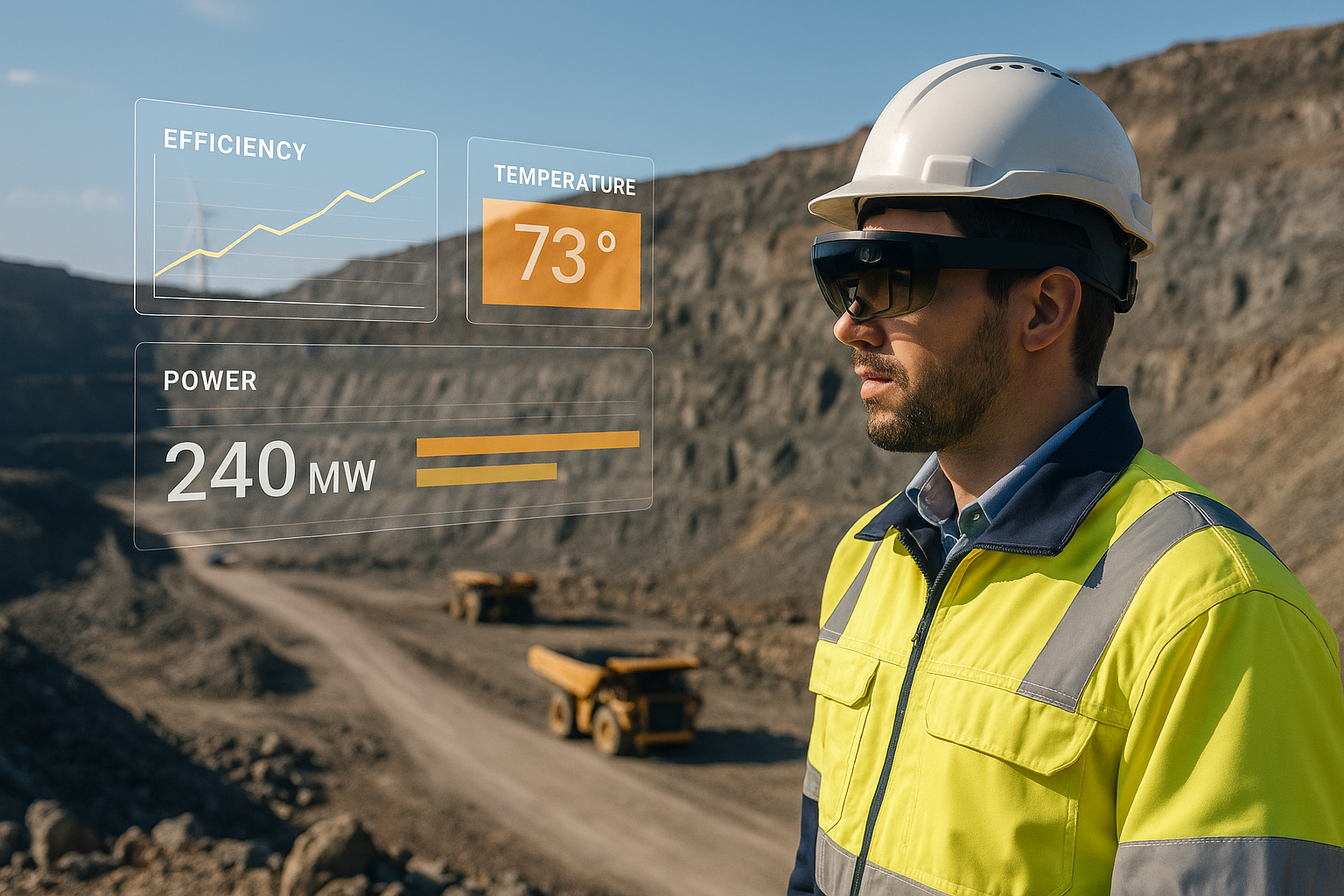
What’s new in AR this month? In September 2025, Anglo American and Rio Tinto launched AR-integrated mine management platforms that provide spatial data overlays for underground operations. Meanwhile, Australia’s Mining Innovation Hub announced an AR-assisted safety training system, using real-time hazard visualization and digital twins of mining tunnels. These advances mark a turning point for the extractive industries, as Augmented Reality (AR) transforms the way mining operations are planned, executed, and monitored for safety and sustainability.
The Role of AR in Modern Mining
Mining has always required precision, coordination, and constant risk management. AR bridges these elements by merging digital intelligence with on-site operations. By overlaying sensor data, geological maps, and safety alerts on physical environments, AR helps operators make faster, safer, and more informed decisions underground and on the surface.
Key Applications of AR in Mining
1. Exploration and Geological Mapping
AR tools allow geologists to visualize subsurface mineral formations in 3D. By integrating seismic and drone data, they can overlay geological structures directly on terrain. This improves exploration accuracy and reduces the need for extensive physical drilling.
2. Equipment Maintenance and Repair
Technicians use AR glasses to perform guided maintenance on heavy machinery such as drills, crushers, and haul trucks. Real-time overlays highlight wear zones and display torque or lubrication specifications, reducing downtime by up to 25%.
3. Worker Safety and Training
AR simulations train miners in emergency scenarios such as gas leaks or equipment failures. In live operations, AR wearables alert workers to nearby hazards, falling rock zones, or vehicle proximity using spatial warnings. This has led to measurable reductions in accidents across major mines adopting the technology.
4. Environmental Monitoring
AR enables engineers to visualize water flow, dust levels, and environmental impact areas in real time. This makes it easier to manage emissions, comply with regulations, and implement sustainable remediation strategies.
Case Studies: AR in Mining Operations
1. Anglo American – Smart Mine Initiative
Anglo American’s smart mine system uses AR dashboards to monitor vehicle fleets and environmental data. Supervisors can see real-time CO₂ emissions, equipment temperatures, and geolocation data overlaid onto the mine site via tablet or headset.
2. Rio Tinto – Remote Operations Center
Rio Tinto’s AR-enabled control rooms in Perth visualize mining operations thousands of kilometers away. Operators interact with holographic digital twins of open-pit mines, improving decision-making and reducing on-site labor by 30%.
3. Sandvik – AR Maintenance for Underground Equipment
Sandvik’s AR service platform projects maintenance steps over mining equipment. Field engineers perform tasks hands-free, guided by 3D animations and remote assistance, cutting repair time by nearly half.
How AR Improves Sustainability in Mining
Mining companies are under increasing pressure to reduce their environmental footprint. AR helps achieve this by enabling resource optimization and better reclamation planning. Visualizing blast impacts, waste flow, and energy use allows planners to minimize waste and improve post-mining land restoration.
Challenges and Limitations
- Hardware Durability: AR devices must function reliably in dark, dusty, and high-vibration environments.
- Data Bandwidth: Underground operations need robust 5G or mesh network connectivity for real-time AR streaming.
- Adoption Costs: Initial setup of AR infrastructure, including digital twin modeling, can be capital-intensive.
- Training Requirements: Workers must adapt to using AR tools efficiently in field conditions.
Future Outlook: The Smart Mine 2030 Vision
By 2030, AR will be a core component of autonomous mining systems. Combined with AI and robotics, AR will allow supervisors to oversee entire mining fleets from remote control centers. Digital twins will visualize every process—from ore extraction to logistics—allowing optimization in real time. As environmental accountability grows, AR will also serve as a communication bridge, helping mining companies show transparent, data-backed sustainability performance to governments and communities.
Key Takeaways
- AR enhances safety and operational efficiency through spatial awareness and predictive monitoring.
- Integration with digital twins enables real-time decision-making across exploration, extraction, and logistics.
- Smart mining ecosystems driven by AR and AI will define the future of sustainable resource management.