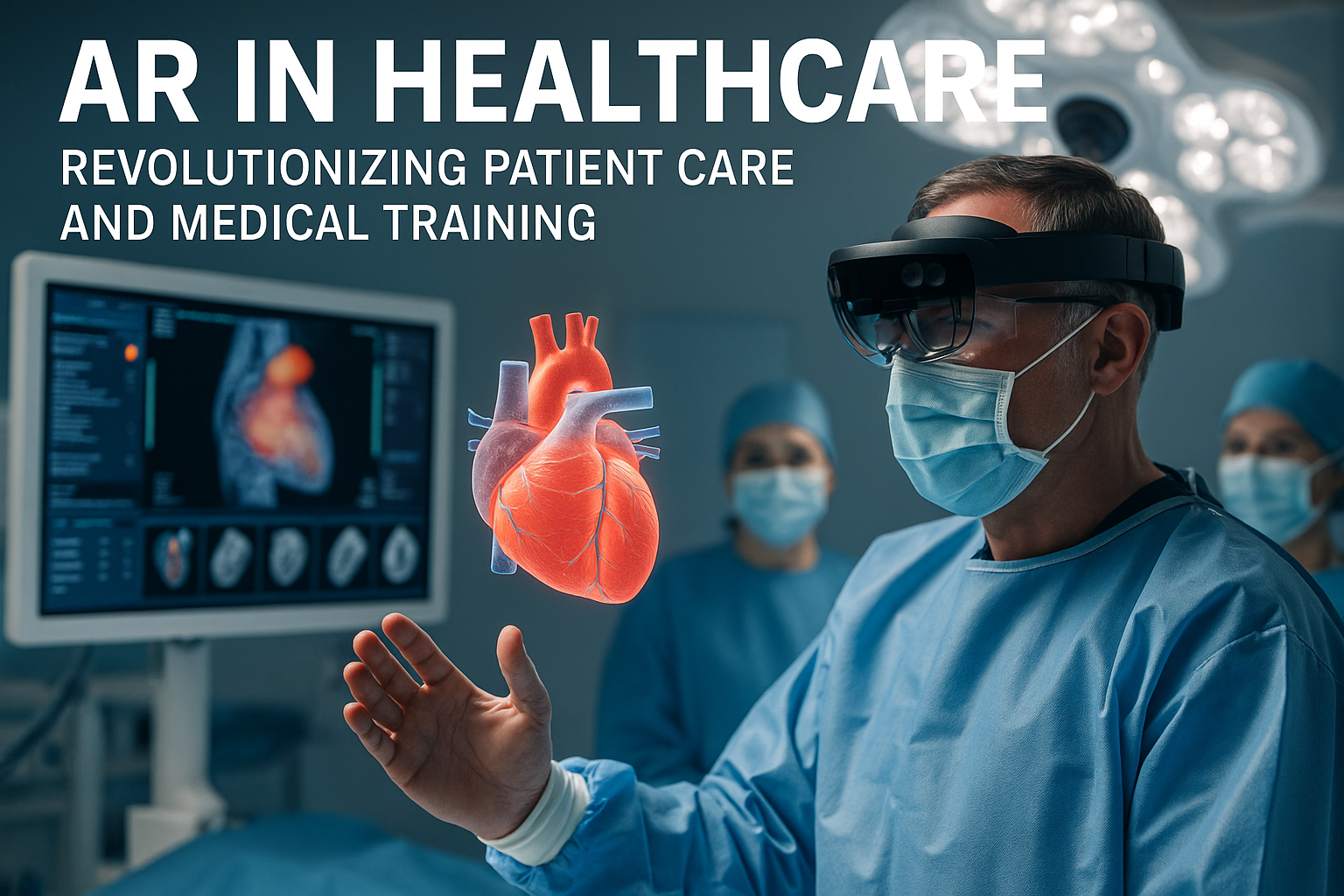
What’s new in AR this month? In September 2025, Philips Healthcare introduced its new AR surgery suite that overlays patient vitals and MRI data onto the surgeon’s field of view. Simultaneously, the Mayo Clinic and Siemens Healthineers launched an AR-based remote diagnostic system allowing doctors to visualize patient scans in 3D from anywhere in the world. These innovations underscore how Augmented Reality (AR) is redefining healthcare by improving accuracy, communication, and patient outcomes.
The Role of AR in Healthcare Transformation
Healthcare is one of the most promising sectors for AR adoption. From surgical visualization to patient education, AR offers a more intuitive, immersive approach to medicine. By projecting digital data directly into the real-world environment, doctors can see anatomy in 3D, simulate complex procedures, and collaborate across continents. For patients, AR provides clarity and confidence—making invisible processes visible and understandable.
Key Applications of AR in Healthcare
1. Surgical Assistance and Visualization
AR enables surgeons to overlay CT and MRI scans onto the patient’s body during an operation. These overlays act as a real-time anatomical guide, improving precision and reducing complications. For instance, AR navigation tools like Microsoft HoloLens-assisted surgery have demonstrated accuracy gains of over 20% in orthopedic and neurosurgical procedures.
2. Medical Education and Simulation
AR has become indispensable for medical training. Students can interact with 3D anatomy models, observe simulated surgeries, and practice procedures without risk. Platforms like Medivis and Touch Surgery are revolutionizing how future doctors learn, allowing them to explore patient cases interactively rather than passively through textbooks.
3. Patient Care and Therapy
In patient care, AR applications range from explaining diagnoses through interactive visuals to improving rehabilitation outcomes. For example, stroke patients using AR-based physical therapy tools perform guided exercises in real time, while therapists track motion accuracy via spatial sensors. The result is higher engagement and faster recovery.
4. Remote Collaboration and Diagnostics
Telemedicine enters a new era with AR. Through shared AR environments, specialists can examine patient scans, annotate findings, and guide on-site clinicians. This approach bridges the gap between remote expertise and local care, especially in rural or resource-limited settings.
Case Studies: AR in Action
1. Philips – AR-Enhanced Surgery
Philips’ AR surgical suite overlays diagnostic imaging data directly onto the surgeon’s field of view. Surgeons can visualize hidden organs, blood vessels, and tumors without looking away from the patient. This reduces procedure time and enhances precision during minimally invasive surgeries.
2. Mayo Clinic – Remote AR Diagnostics
The Mayo Clinic uses AR to connect radiologists and on-site doctors through shared holographic images of patient scans. By merging 3D models with AI-driven analysis, specialists identify abnormalities in real time, even across continents.
3. Johns Hopkins – AR in Neurosurgery
Johns Hopkins University successfully conducted spinal fusion surgeries using AR headsets that project 3D anatomical markers over the patient’s body. The system reduced surgical errors and improved implant accuracy by 98% compared to traditional techniques.
Benefits of AR in Healthcare
- Improved Accuracy: Real-time visualization minimizes surgical errors and enhances diagnosis precision.
- Faster Training: Medical students gain hands-on experience through simulated 3D environments.
- Patient Empowerment: AR visualizations help patients understand their conditions better.
- Global Collaboration: Specialists can consult and guide procedures remotely in real time.
- Cost Efficiency: Reduces the need for physical models and accelerates procedural planning.
AR and AI: The Future of Precision Medicine
When integrated with AI, AR becomes a diagnostic powerhouse. AI algorithms analyze medical images and overlay insights directly into the surgeon’s AR display. For example, AI-driven AR can highlight suspicious tissue regions or suggest incision points. In radiology, AR enhances AI’s interpretability, helping doctors visualize abnormalities instead of relying on static 2D scans.
AR in Mental Health and Rehabilitation
Beyond diagnostics, AR is transforming therapy. Mental health professionals use AR exposure therapy to treat phobias and PTSD, allowing patients to face controlled, realistic simulations safely. Rehabilitation programs use AR-assisted exercises to improve coordination, balance, and engagement, making therapy more effective and enjoyable.
Challenges in AR Healthcare Implementation
- Hardware Limitations: AR headsets must be lightweight, sterilizable, and suitable for long-term use in clinical environments.
- Data Security: Protecting sensitive patient data in AR platforms remains a top concern.
- Integration Complexity: AR systems need seamless compatibility with existing hospital information systems and imaging databases.
- Training Requirements: Medical professionals must adapt to AR-assisted workflows to fully leverage its benefits.
Future of AR in Healthcare
By 2030, AR will be an essential layer of digital healthcare infrastructure. From emergency rooms to home care, AR interfaces will guide decisions, visualize patient conditions, and automate data sharing. Hospitals will operate as “smart care environments,” where AR seamlessly connects diagnostics, treatment, and education in real time.
Key Takeaways
- AR enhances precision and understanding across all levels of healthcare—from surgery to rehabilitation.
- Integration with AI and IoT will create intelligent ecosystems for continuous patient monitoring and predictive care.
- Patient-centered care becomes more transparent and engaging with AR-driven communication tools.
- The future of medicine will blend AR visualization with robotics, creating fully connected smart hospitals.