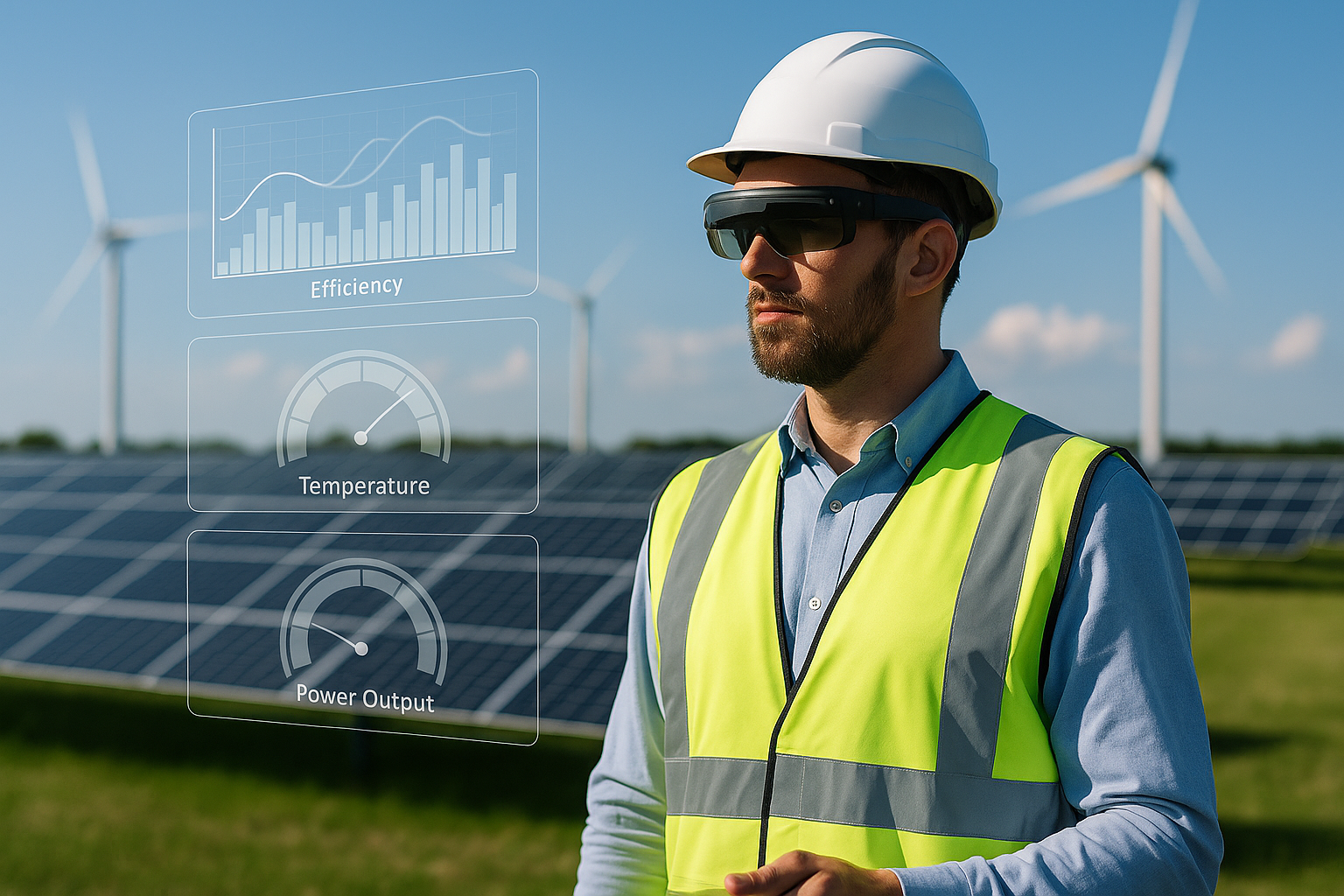
What’s new in AR this month? In September 2025, General Electric (GE) and Schneider Electric announced new AR-integrated maintenance systems for renewable energy facilities. These platforms allow field engineers to visualize grid performance, turbine efficiency, and real-time fault detection directly through AR glasses. Meanwhile, Japan’s Energy Agency launched an AR-driven training module for nuclear plant operators, designed to enhance safety and predictive maintenance. These developments confirm that Augmented Reality (AR) is becoming an essential part of the global energy transition—improving sustainability, reliability, and human performance.
The Role of AR in Energy Innovation
The energy sector is shifting toward decentralized, data-driven systems. Wind farms, solar arrays, and smart grids all require precise coordination and rapid maintenance response. AR enables engineers and operators to visualize invisible data—such as voltage flow, thermal loads, or stress patterns—over physical assets. This real-time insight allows for predictive maintenance, safer operations, and more efficient energy distribution.
Key Applications of AR in the Energy Industry
1. Predictive Maintenance and Diagnostics
Technicians use AR headsets to view live data overlays from IoT sensors attached to turbines, transformers, and solar inverters. AR visualizations highlight components under stress or nearing failure, enabling preventive action before costly breakdowns occur. Companies using AR diagnostics have reported up to 35% reductions in downtime.
2. Grid Visualization and Smart Monitoring
Energy control centers now employ AR dashboards to manage distributed power sources. By projecting live energy flow and grid performance onto digital twins, operators can identify inefficiencies, reroute electricity dynamically, and balance renewable inputs with demand in real time.
3. Safety Training and Field Operations
AR provides immersive safety simulations for field engineers working in hazardous environments. Instead of reading manuals, trainees interact with 3D overlays showing proper procedures for handling high-voltage systems or emergency shutdowns. This approach improves retention and reduces human error.
4. Infrastructure Planning and Visualization
AR allows planners to visualize new substations, pipelines, or wind installations on actual terrain before construction. Spatial visualization helps assess environmental impact, optimize positioning, and communicate complex data clearly to stakeholders.
Case Studies: AR in Action
1. GE Renewable Energy – Wind Turbine Maintenance
GE uses AR headsets for turbine inspection and repair. Technicians can see internal component data, torque instructions, and real-time sensor feedback. The system reduced maintenance time by 28% and improved worker safety across remote wind farms.
2. Shell – AR for Oil and Gas Operations
Shell implemented AR systems in offshore platforms for equipment diagnostics and remote assistance. Experts guide field staff through live AR annotations, minimizing downtime and cutting travel costs by over 20%.
3. Schneider Electric – Smart Grid Management
Schneider’s EcoStruxure AR platform lets engineers overlay electrical schematics on live panels. This visual context enables faster troubleshooting and better coordination between field teams and control centers.
How AR Supports Sustainability Goals
By reducing energy waste and optimizing operations, AR contributes directly to global sustainability objectives. Visual monitoring of renewable energy assets ensures optimal performance, while predictive maintenance minimizes material waste and emissions. AR also accelerates workforce training for clean energy technologies, addressing one of the sector’s biggest talent gaps.
Challenges and Considerations
- Hardware Limitations: AR glasses must withstand extreme conditions like offshore winds or desert heat.
- Data Integration: Merging AR systems with legacy SCADA and IoT platforms requires robust middleware.
- Cybersecurity: Protecting live operational data visualized through AR remains a top priority.
- Scalability: Implementing AR across thousands of assets demands cloud-based synchronization and bandwidth optimization.
Future of AR in Energy Systems
By 2030, AR will play a key role in smart grid automation and distributed renewable management. Engineers will interact with real-time digital twins of entire power networks through AR interfaces. Predictive algorithms, visualized in 3D, will guide automated decisions on load balancing, fault detection, and maintenance scheduling. In this new paradigm, AR will become the operational language of energy systems—intuitive, visual, and adaptive.
Key Takeaways
- AR empowers sustainable energy operations through predictive analytics and immersive visualization.
- Smart grids and renewable systems benefit from AR-integrated real-time monitoring.
- By combining AR, AI, and IoT, the energy industry can achieve higher efficiency, lower emissions, and greater resilience.